
-
© materialmatters / Robert Vanis
-
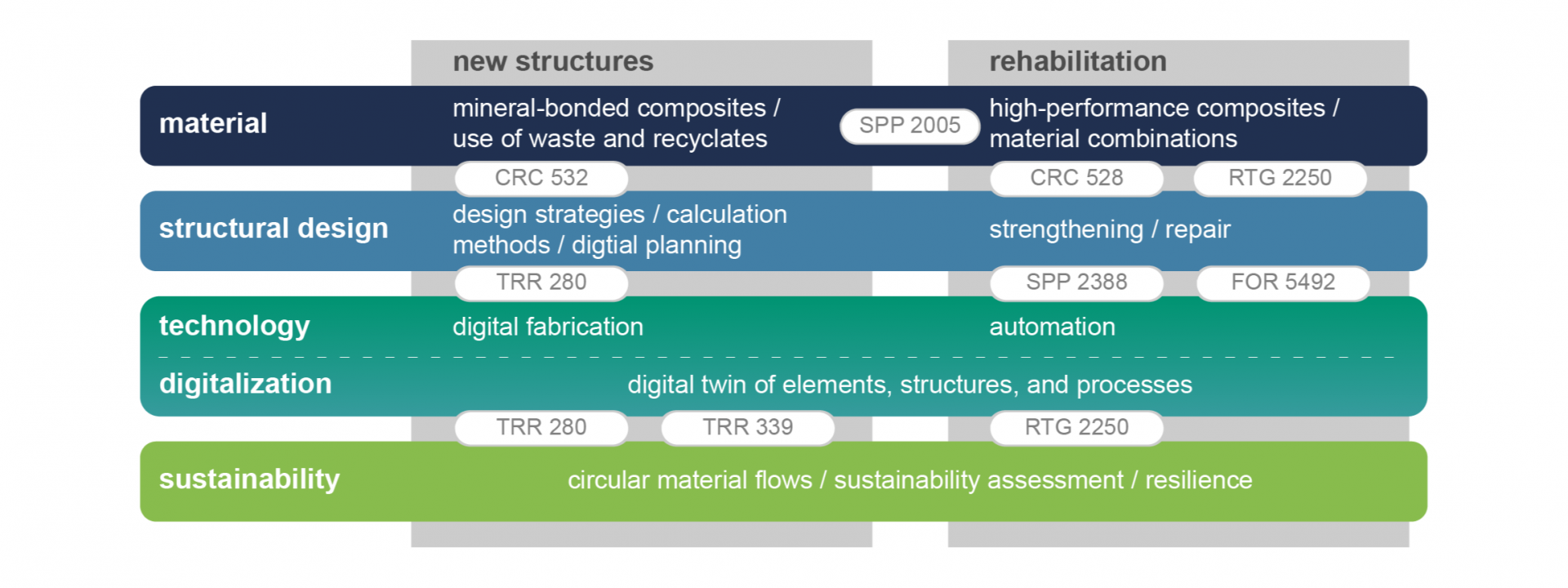
A matrix illustrating the research structure leading to CARE, covering the topics of materials, construction, technology, digitalisation and sustainability, divided into new builds (new structures) and refurbishment (rehabilitation), with associated research consortia. © neongrau
CARE builds on a long history of successful collaboration and a strong foundation of completed and ongoing research initiatives.
This collaboration began with two major research projects launched at the same time at the TU Dresden and RWTH Aachen University: Textile Reinforcement for Structural Strengthening and Repair at TU Dresden and Textile-Reinforced Concrete – Development of a New Technology at RWTH Aachen University, both conducted from 1999 -2011. The projects investigated the use of textile reinforcement to improve the strength, durability, and service life of concrete structures.
Building on this foundation, the large-scale Carbon Concrete Composite (C3) project was launched in 2014 with funding from the German Federal Ministry of Education and Research. Led by TU Dresden and involving researchers from RWTH Aachen University, the initiative has developed into a nationwide network of more than 150 partners from academia, industry, and public authorities. Its goal is to transfer cutting-edge research on carbon-reinforced concrete into construction practice.
- 2024
-
The DFG Research Unit FOR 5492 ‘Polytope Mesh Generation and FEA Methods for Problems in Solid Mechanics’, was established in 2024. CARE Principal Investigators Professor Klinkel and Professor Kobbelt, both RWTH Aachen University, are involved in the initiative. The Research Unit addresses the increasing geometric complexity of components in automated CAD, CAE, and CAM workflows resulting from advances in three-dimensional object digitization and digital fabrication. It develops innovative methods for mesh generation and finite element analysis to support the efficient digital design and analysis of complex structures.
This research contributes to CARE goal #3 [Increasing Productivity], by advancing productivity in digital design and manufacturing.
- 2022
-

The Living Art of Building (LAB) initiative brought together researchers from several disciplines and institutions to develop a broad vision for sustainable construction. LAB and CARE were developed in parallel and in close dialog, with exchanges between the two initiatives contributing to the further development of their respective concepts and collaborative networks.
Although LAB was not implemented in the form originally envisioned, several elements of its transfer-oriented approach are being taken forward by the Bundesforschungszentrum (BFZ), which is currently being established in Bautzen as a German registered association (e.V.). CARE plans to cooperate closely with BFZ, particularly in knowledge and technology transfer, collaboration with industry, and the demonstration and practical implementation of innovative construction solutions.
- 2022
-

Since 2022, the DFG Proirity Program, SPP 2388 'Hundred plus – Extending the Lifetime of Complex Engineering Structures through Intelligent Digitalization' with CARE PI Professor Marx as spokesperson, has focused on developing digital models and indicators for assessing the condition of engineering structures.
Its research supports CARE's goals of extending the service life of structures under CARE goal #02 [Enhancing Resource Efficiency] and advancing digital methodologies under CARE goals #02 [Enhancing Resource Efficiency] and #03 [Increasing Productivity].
- 2022
-

Launched in 2022, the Aachen-Dresden DFG Collaborative Research Center CRC/TRR 339 'Digital Twin of the Road System' with CARE PI Blankenbach as co-spokesperson, integrates material and structural models with dynamic traffic data to improve the sustainability and efficiency of road infrastructure.
The project contributes to CARE goal #03 [Increasing Productivity] and goal #05 [Boosting Resilience and Adaptability to Climate Change]. It also provides an excellent basis for CARE's work on end-to-end digitalization across the construction value chain.
- 2020
-

Since 2020, researchers of TU Dresden and RWTH Aachen University have collaborated within DFG CRC/Transregio (TRR) 280 ‘Design Strategies for Material-Minimized Carbon Reinforced Concrete Structures’ with PI Marx as spokesperson. Drawing inspiration from biology, mathematics and art, the project investigates new design principles for mineral-based composite structures.
The extensive research conducted within TRR 280 provides important foundations for CARE. Close interaction between the two initiatives creates valuable synergies, particularly in pursuing CARE goal #01 [Climate Neutrality] and goal #02 [Resource Efficiency] in construction.
- 2019
-

Launched in 2019 with the involvement of several CARE PIs, the DFG Priority Program SPP 2187 ‘Adaptive Modularized Constructions Made in Flux’ focuses on modular construction and scalable manufacturing processes.
The program provides an important foundation for CARE's research on modular structures under goal #02 [Resource Efficiency] and digitally supported manufacturing under CARE goal #03 [Increasing Productivity]. CARE extends these approaches by incorporating circularity principles and developing adaptive modular structures designed for efficient disassembly, reuse, and reconfiguration after their initial service life.
- 2018
-
The DFG Priority Program SPP 2005 'Opus Fluidum Futurum – Rheology of Reactive, Multiscale, Multiphase Construction Materials' ran from 2018 to 2025, with CARE PI Mechtcherine as spokesperson. The program developed a comprehensive scientific framework for rheology-based construction processes and supported the advancement of innovative manufacturing technologies and sustainable construction materials.
The knowledge and methods generated within SPP 2005 provide important foundations for CARE goal #01 [Climate Neutrality] and goal #03 [Increasing Productivity].
- 2017
-
The DFG Research Training Group (RTG) 2250 ‘Mineral-bonded Composites for Enhanced Structural Impact Safety’ was conducted at TU Dresden from 2017 to 2026, with CARE PI Mechtcherine as spokesperson. It investigated how thin layers of mineral-based composites can improve the impact resistance of structures.
The material concepts and strengthening methods developed within the RTG are closely aligned with CARE's research objectives, particularly the development of innovative, resource-efficient materials and solutions for improving structural resilience under CARE goals #01 [Climate Neutrality], #02 [Enhancing Resource Efficiency] and #05 [Boosting Resilience and Adaptability to Climate Change].